
AEO content means creating content that gives a clear answer first, matches the user’s search intent, and is easy for Google, AI tools, and readers to understand. To create AEO content, you need to write direct answers, use clean structure, add real experience, answer FAQs, and keep the content useful instead of just keyword-focused.
AEO does not mean ignoring SEO. It means improving SEO content so it can perform better in today’s search experience, where users are getting answers from Google, AI Overviews, ChatGPT, and other AI-driven platforms.
Why I Started Taking AEO Seriously
Earlier, SEO content was mostly written for Google rankings. We used to focus on keywords, headings, internal links, and backlinks. These things still matter, but search behavior has changed.
Now users are not only searching on Google. They are also asking questions on AI tools like ChatGPT. Even Google is showing more direct answers before normal website results.
I noticed this change in real data.
In one of my analytics reports, traffic was not only coming from Google, Bing, Yahoo, and direct sources. There was also traffic coming from chatgpt.com. That means users are discovering websites through AI platforms too.
This is a clear signal: content should not only be written for traditional search engines. It should also be written in a way that AI systems can understand, summarize, and refer to.
That is where AEO becomes important.
What Is AEO?
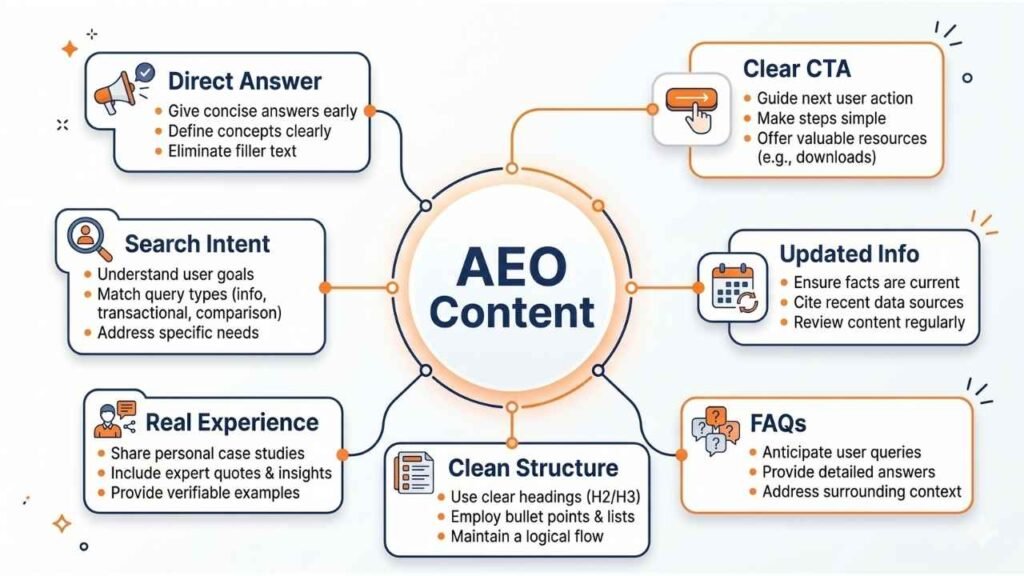
AEO means Answer Engine Optimization.
In simple words, AEO means writing content in a way that clearly answers the user’s question, solves the reader’s problem, and helps search engines or AI systems understand the page.
Good AEO content is:
- Direct
- Useful
- Structured
- Honest
- Easy to read
- Based on real user intent
- Supported by examples, proof, or experience
AEO content is not about writing more words. It is about writing better answers.
SEO vs AEO: Simple Difference
| Point | Traditional SEO Content | AEO Content |
|---|---|---|
| Main focus | Ranking for keywords | Answering the user clearly |
| Opening style | Long introduction | Direct answer first |
| Structure | Keyword-based headings | Question-based and intent-based headings |
| Content depth | General explanation | Practical answer with examples |
| User experience | Reader has to search inside page | Reader gets answer quickly |
| AI-readiness | Sometimes unclear | Easy for AI systems to understand |
| Best result | Traffic | Traffic + trust + leads |
The best strategy is not SEO vs AEO.
The best strategy is:
SEO + AEO = content that ranks, answers, and converts.
Real Example: Ferry International Content

Let’s take a practical example.
Ferry International is an industrial fastener brand dealing in products like anchor bolts, pipe clamps, sprinkler clamps, cable clamps, hinges, and related hardware.
For this kind of B2B business, content cannot be generic. A buyer is not searching just to read information. The buyer may want to know:
- Which anchor bolt size is suitable?
- Who is a reliable anchor bolt manufacturer in India?
- Can the supplier handle bulk orders?
- What material and finish options are available?
- Can they export or supply to a specific location?
- How can I request a quote?
If the page only says “we are the best manufacturer,” it will not help.
But if the page answers actual buyer questions like anchor bolt size, anchor bolt types, bulk order process, material options, and applications, then the content becomes useful for both SEO and AEO.
This is the difference between ordinary content and answer-ready content.
Example Keyword Angle
For Ferry International, instead of writing only generic pages, the content should target useful search angles like:
| Search Topic | Better AEO Page Angle |
|---|---|
| anchor bolt manufacturer in India | Explain product range, materials, applications, bulk supply, and RFQ process |
| anchor bolt size | Add size chart, selection guide, use cases, and FAQs |
| pipe clamp manufacturer | Explain types, materials, industries, and bulk buying process |
| anchor bolt supplier for bulk orders | Focus on procurement, quantity, quality checks, and quotation |
| sprinkler clamps | Explain use case, material, installation support, and buyer questions |
This type of content helps search engines understand the page better and helps buyers make decisions faster.
Why Direct Answers Matter
Most weak blogs start like this:
“Anchor bolts are very important in the construction industry. Nowadays, many companies use anchor bolts for different purposes.”
This is boring and does not answer the user.
A better AEO opening would be:
“Anchor bolts are used to fix structural or machinery components into concrete. The right anchor bolt size depends on load requirement, base material, hole diameter, embedment depth, and application type. For bulk buying, buyers should check material grade, coating, thread size, and supplier quality process before ordering.”
This is better because it gives useful information immediately.
AEO Content Structure You Should Follow
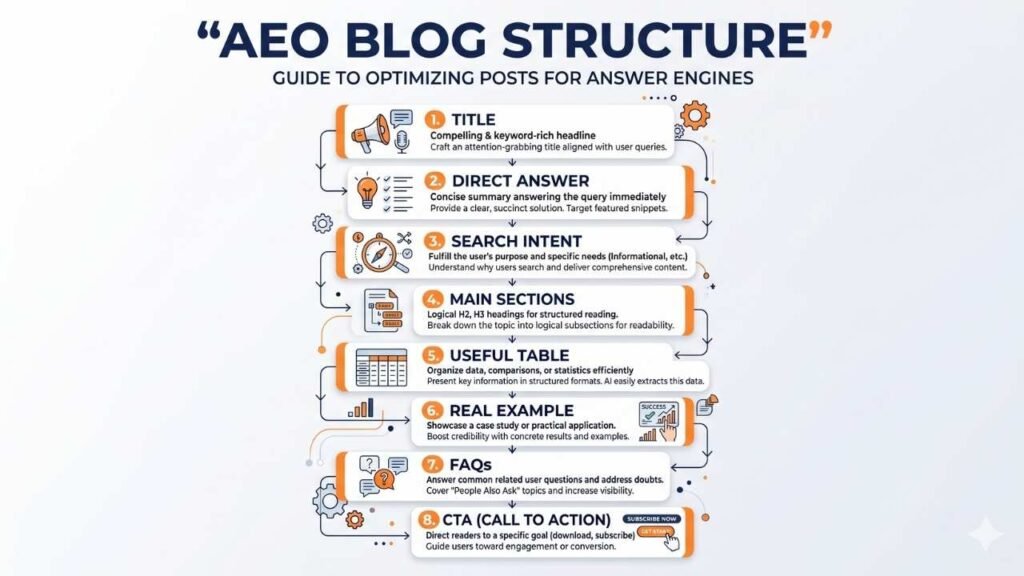
A good AEO blog or page should follow this structure:
| Order | Section | Purpose |
|---|---|---|
| 1 | H1 Title | Clearly define the topic |
| 2 | Direct Answer | Answer the main question immediately |
| 3 | Who It Helps | Show who the content is for |
| 4 | Main Explanation | Explain the topic clearly |
| 5 | Table or Comparison | Make information easy to understand |
| 6 | Real Experience | Add practical observation or proof |
| 7 | FAQs | Answer real doubts |
| 8 | CTA | Tell the reader what to do next |
This structure works for blogs, product pages, service pages, and location pages.
Step 1: Understand Search Intent
Before writing content, understand why the person is searching.
For example, if someone searches “anchor bolt size”, they may want a size chart, selection guide, or technical explanation.
If someone searches “anchor bolt manufacturer in India”, they are likely looking for a supplier, product range, quality, and quotation process.
If someone searches “best content for SEO”, they may want a framework, examples, or writing process.
So the first job is to understand the intent.
Prompt to Find Search Intent
Act as an SEO and AEO content strategist.

Topic: [TOPIC]
Audience: [AUDIENCE]
Business/client: [BUSINESS DETAILS]
Goal: [TRAFFIC / LEADS / ENQUIRY / SALES]

Give me:
1. Main search intent
2. Reader pain points
3. Must-answer questions
4. Best content angle
5. Sections this page should include

Keep the output practical and useful.
Step 2: Write the Direct Answer First
The first 100 words should not waste time. They should answer the main question clearly.
This does not mean every blog must follow the same format. It means the reader should understand the main answer quickly.
Direct Answer Formula
Use this:
[Topic] means [simple explanation]. It is useful for [audience/problem]. To do it properly, focus on [main steps/factors].
Example
Topic: How to create AEO content
Direct answer:
“AEO content is content written to answer the user’s question clearly and quickly. To create AEO content, start with search intent, write a direct answer, use clean headings, add real examples, include FAQs, and keep the content updated.”
Prompt to Write Direct Answer
Write a direct answer introduction for this topic: [TOPIC]

Audience: [AUDIENCE]
Search intent: [SEARCH INTENT]
Business/client: [BUSINESS DETAILS]

Rules:
- Start with a clear answer
- Keep it under 100 words
- Avoid generic introduction
- Avoid fake claims
- Make it easy for a beginner to understand
Step 3: Add Real Experience
AI content often sounds clean but generic. Real experience makes your content stronger.
Real experience can include:
- What you noticed while working on a client project
- Common mistakes buyers or users make
- Real examples from your SEO work
- Product knowledge
- Process explanation
- Practical observations
- Before/after improvements
Example From SEO Work
If a page is getting impressions but clicks are low, the problem may not always be ranking. Sometimes the page title, opening answer, and content structure are weak.
If the user gets the answer from AI or from the search result itself, your content needs to be clearer and more useful to win attention.
This is why AEO content should not just repeat keywords. It should solve the question better than other pages.
Prompt to Add Real Experience
Add a practical experience section for this topic: [TOPIC]

Business/client details: [DETAILS]
Audience: [AUDIENCE]
Available proof or experience: [EXAMPLES / PROCESS / OBSERVATIONS]

Write:
1. A short practical observation
2. Common mistake people make
3. What should be done instead
4. A real-sounding example

Keep it honest and useful.
Step 4: Use Tables for Clarity
Tables help readers understand information faster. They also make the page easier to scan.
For example, if you are writing about anchor bolt sizes, a table can show:
- Bolt type
- Size range
- Application
- Material
- Use case
If you are writing about AEO content, a table can show:
- SEO vs AEO
- Blog structure
- Content checklist
- Prompt workflow
Prompt to Create Tables
Create useful tables for this topic: [TOPIC]

Audience: [AUDIENCE]
Search intent: [SEARCH INTENT]

Give me:
1. One comparison table
2. One checklist table
3. One decision-making table

Keep all tables useful for readers, not decorative.
Step 5: Add FAQs Based on Real Questions
FAQs are powerful for AEO because users ask questions.
But FAQs should not be random. They should answer real doubts.
For example, on an anchor bolt page, useful FAQs can be:
- What size anchor bolt do I need?
- Which anchor bolt is used for concrete?
- Do you provide bulk anchor bolt supply?
- Can anchor bolts be customized?
- What details are needed for quotation?
For an AEO content blog, useful FAQs can be:
- Is AEO different from SEO?
- How do I write answer-ready content?
- Does AEO help in Google ranking?
- Can AI-written content be optimized for AEO?
- What should be added in the first paragraph?
FAQ Prompt
Create an FAQ section for this topic: [TOPIC]

Audience: [AUDIENCE]
Search intent: [SEARCH INTENT]

Rules:
- Write 8 to 10 real user questions
- Keep answers short and helpful
- Avoid fake claims
- Include beginner-level and decision-level questions
Step 6: Keep Content Updated
AEO content should not feel outdated.
Update these things regularly:
- Pricing
- Product details
- Service process
- Eligibility
- Policies
- Screenshots
- Examples
- FAQs
- Statistics
- CTA
For example, if you are writing about online MBA colleges, fees and eligibility must be updated.
If you are writing about industrial fasteners, product specifications, material details, and order process should be clear.
If you are writing about SEO or AEO, update examples based on current search behavior.
Prompt to Update Old Content
Review this content and suggest updates.

Content: [PASTE CONTENT]
Topic: [TOPIC]
Audience: [AUDIENCE]

Check:
1. Outdated information
2. Weak direct answer
3. Missing examples
4. Missing FAQs
5. Weak structure
6. Better CTA
7. Sections that need improvement

Give me a practical improvement plan.
Step 7: Add a Clear CTA
Content should not end suddenly. AEO content should guide the reader to the next step.
CTA depends on the page goal.
| Page Type | CTA Example |
|---|---|
| Blog | Download guide, read next blog, contact for help |
| Service page | Request consultation |
| Product page | Request quote |
| B2B page | Send size, quantity, and requirement |
| Personal brand page | DM, follow, download PDF |
For example, in this blog, the CTA can be:
Download the free AEO Content Builder PDF with prompts and use it to create answer-ready blogs and pages.
Full Master Prompt to Create AEO Content
Use this prompt when you want to create a complete blog or page.
Write a detailed SEO + AEO optimized blog/page on this topic: [TOPIC]

Audience: [AUDIENCE]
Business/client: [BUSINESS DETAILS]
Goal: [GOAL]
Search intent: [SEARCH INTENT]
Available proof/experience: [PROOF OR EXPERIENCE]

Content requirements:
1. Start with a direct answer
2. Use simple English
3. Match the search intent
4. Add real experience and practical examples
5. Use clear H2 and H3 headings
6. Add useful tables where needed
7. Add an FAQ section
8. Avoid fake claims and keyword stuffing
9. Keep the content helpful, honest, and easy to understand
10. End with a clear CTA

Write in a professional but beginner-friendly tone.
Free Download: AEO Content Builder PDF
If you want a simple step-by-step framework to create AEO-friendly blogs and pages, download my free PDF guide.
This PDF includes:
- AEO content structure
- Search intent prompt
- Direct answer prompt
- Real experience prompt
- FAQ prompt
- Blog structure table
- Final checklist
- Master content prompt
Use it for your own blogs, client blogs, service pages, product pages, and SEO content planning.
Download Free AEO Content Builder PDFFAQs About AEO Content
AEO content is content written to answer user questions clearly and quickly. It is structured so readers, search engines, and AI systems can understand the page easily.
Yes, but both are connected. SEO focuses on visibility in search engines. AEO focuses on creating clear, answer-ready content. Good content should use both SEO and AEO.
No. AEO does not guarantee ranking. It improves content quality, structure, and usefulness, which can support better SEO performance.
The first paragraph should directly answer the main question. Avoid long generic introductions.
Yes, but it must be edited with real examples, clear structure, updated information, and helpful answers. Pure AI content without human review can sound generic.
Usually 6 to 10 useful FAQs are enough for most blogs. Add questions that real users may ask.
Not every blog needs a table, but tables are useful when you are explaining comparisons, steps, pricing factors, sizes, types, or decisions.
The biggest mistake is writing long content without answering the main question clearly. More words do not always mean better content.
Final Checklist Before Publishing
Before publishing any AEO blog or page, check this:
| Question | Yes/No |
|---|---|
| Does the page answer the main question near the top? | |
| Is the first paragraph useful? | |
| Does the content match search intent? | |
| Are headings clear? | |
| Are paragraphs short? | |
| Is there a useful table where needed? | |
| Is real experience or example added? | |
| Are FAQs included? | |
| Is the content updated? | |
| Is the CTA clear? | |
| Are fake claims removed? | |
| Is the page useful for a real person? |
Conclusion
AEO content is not about tricks. It is about writing content that gives better answers.
If you want your content to perform in modern search, do not only focus on keywords. Focus on search intent, direct answers, real examples, clean structure, FAQs, and updated information.
Whether you are writing for your own website or a client website, the rule is simple:
Do not just create content. Create useful answers.
If you want to make this process easier, download the free AEO Content Builder PDF and use the prompts inside it to plan your next blog or page.